

Ranch History
Our Line 1 Legacy
1914
Cooper Hereford Ranch Homesteaded
Frank Oscar Cooper established our family’s agricultural roots in the Gallatin Valley of Montana in 1914 when on November 28th he laid claim to 480 acres near Willow Creek and called it ‘Silver Brook Farm’.


Mid 1900s
The Rise of the Beef Industry
In the mid-1900s, the beef industry underwent a transformative shift with the widespread adoption of feedlot systems. This transition led to changes in cattle genetics as ranchers began to focus on raising cattle with traits that favored faster growth and higher meat yields.
Early 1930s
Line 1 research project at Fort Keogh Livestock & Range research lab
Scientists at the USDA Research Station in Miles City begin to lay the framework for what would become the longest running beef cattle selection experiment in the World - the Line 1 research project. At the time, visual appraisal and success in the show ring were often the primary selection criteria for seedstock producers as there was no practical way to scientifically measure genetic progress or change in beef cattle. Scientists working on the Line 1 project were focused on establishing methods of measuring performance while attempting to prove that traits such as fertility, weaning weight and yearling weight were inheritable and could be improved through selection. The results laid a solid foundation for improving and evaluating genetics and performance in beef cattle which would became the bedrock of modern genetic evaluation for all breeds.

.png)
.png)
Late 1930s - 1940s
Jack makes initial purchase of 40 Line 1 females in 1947
Unimpressed by the cattle generally winning in the shows, Jack (Frank’s son) set his mind to producing growthier cattle suited for the commercial bull market. Simultaneously, Jack’s brother-in-law, Dr. Ray Woodward, was named the lead beef geneticist at Fort Keogh, a position he held for 14 years (1946-1960). A firm believer in achieving genetic progress through line-breeding and performance-based selection, Dr. Woodward convinced Jack to invest in 40 Line 1 females from the Experiment Station in 1947.
1947
“I got interested in Miles City cattle in 1947. A lot of people at that time were making all selections by visual appraisal, but I didn’t think that way was very profitable. A lot of registered breeders didn’t believe in performance testing then, but most do now. I think it would be hard to sell bulls without a performance background.” – Jack Cooper

.png)
1950s - 1960s
Genetic progress through record keeping and trait selection
Montana Beef Performance Association (MBPA), charter member
From the onset of his initial purchase of Line 1 females, Jack began number branding and keeping precise records of birth, weaning and yearling weights, along with other records of maternal importance. In 1956, other like-minded ranchers in Montana teamed up to form the Montana Beef Performance Association (MBPA), whose mission over the years evolved from providing ranchers with a simple records keeping center to being a pioneer in herd selection methods. Jack was a charter member of the MBPA and had over 10 years worth of data recorded when he joined. The early work of the MBPA and its founders helped to establish Montana as a leader in performance testing and genetics, influencing the beef industry far beyond state lines. And undoubtedly, many of the principles that laid the framework for similar breed-based improvement programs were first established through the Line 1 project.
April 1967
Inaugural "Cooper-Holden" Production Sale
By the late 1960s, Jack makes the decision to try the auction route for marketing his bulls. He teams up with half-brother Les Holden, who had simultaneously been growing his own herd of Line 1 cattle in Valier, MT. The duo joined forces through a 13-year period to hold annual spring auctions at the Great Falls Stockyard. The two men independently operated their own ranches and herds but cooperated with each other greatly, even to the extent of aiming to wean their calves on the same day and striving towards similar weight-gain goals. They regularly exchanged herd bulls in seeking to avoid any possible risk from breeding too closely.
.png)
.png)
Late 1960s
Continued breed improvement through utilization of advancing new technologies
American Hereford Association Total Performance Records (TPR), charter member
Always on the forefront of breed improvement, Jack began to implement new technologies as they became available. He joined the American Hereford Association’s Total Performance Records (TPR) program as a charter member when it formed in 1964 and sonorayed 60 head of bull calves in 1968 to assess backfat thickness and ribeye areas.
1970s
Jack and Phyllis welcome the 3rd generation back to the operation
Mark returns home to assist with the ranching and farming operations after studying at Montana State University in Bozeman. Together, the father and son duo worked side by side one another to improve their cattle and grow their farming operation by acquiring neighboring parcels of land and expanding irrigation through use of wheellines and center pivot irrigation. Jack’s brother, Dr. Scott Cooper, was an agronomist at Montana State University, and with his help they begin planting a diversified seed mixture consisting of perennial grasses, forbs and legumes for hay production and use as pasture.

1980s
Inaugural ‘Top of the Tops’ bull sale, Willow Creek, MT
Jack inducted into the American Hereford Association Hall of Fame
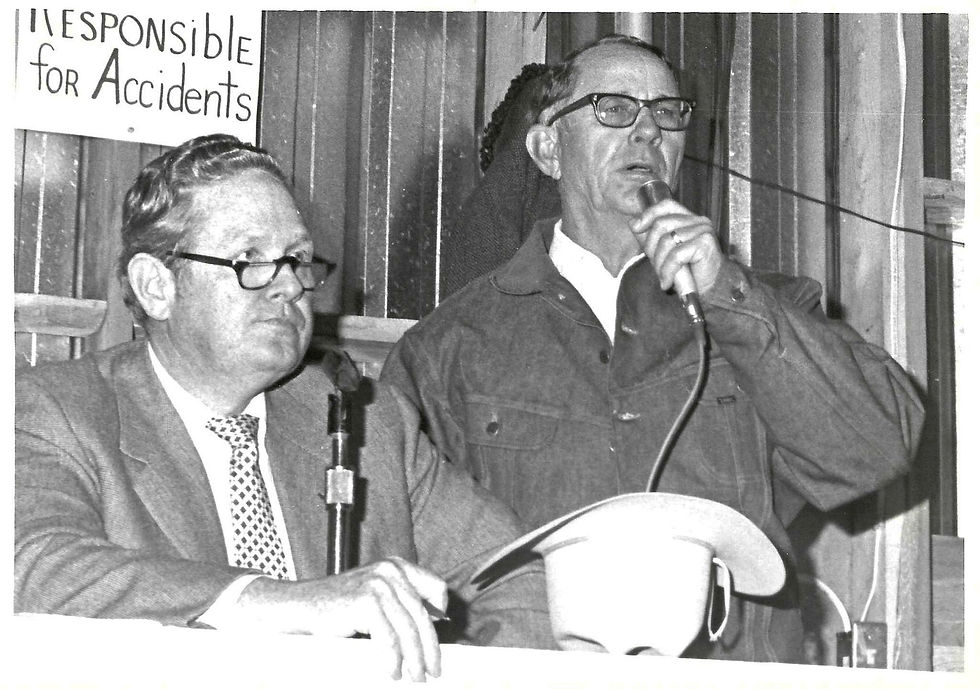
1980 was a monumental year for our family. We hosted our inaugural bull sale at the ranch in March and the industry took note when Weldon Edwards of Clyde, TX and Lee Campbell of Dublin, TX purchased the top yearling bull for $180,000. Later that year Jack was inducted into the American Hereford Association’s Hereford Heritage Hall’s Honor Gallery in Kansas City, MO.
1990s - early 2000s
Fine-tuning genetic evaluation through use of embryo transfer, ultrasound & GE-EPDs
The cattle cycle was hitting a major down-turn by the late 1990s. Breed associations and producers responded to decreased markets by adopting new technologies to increase efficiency and produce higher-quality cattle. With over 20 years of experience integrating artificial insemination within their breeding program, Jack and Mark become early adopters of embryo transfer with their first ET calves being born in 1994. The following year, in 1995, they began utilizing carcass data as another tool to evaluate their cattle, which they gathered by use of ultrasound technology on all yearling bulls and heifers. Having blood typed their entire cow herd and subsequent calf crops for parentage verification since 1985, they were similarly one of the first breeders to submit tissue samples on their entire cow herd and calf crop for GE-EPDs when the new accuracies were released by the Hereford Association in 2012.

.png)
2019
Mark inducted into American Hereford Hall of Fame
Mark and Cristy travel to the AHA headquarters in Kansas City, MO with their four daughters and families to accept Mark’s award.
2020
Recognized as Platinum breeders
Established in 2018, the platinum TPR program recognizes breeders who participate in the Association’s Whole Herd Total Performance Records (TPR) program that was implemented in 2001 to create a more accurate database and increase the value of Hereford genetics. The Platinum TPR breeder is the highest level of achievement when it comes to complete calf crop reporting. Breeders must meet all of the requirements of Gold TPR breeder status plus genotype 85% of their calves with a weaning weight submitted.


Present
4th Generation integrates into daily operation – Katie, Kelsy and son-in-law Dave Hanson
Over the past century, four generations of our family have made great contributions that enabled the original homestead to grow from 480 acres to over 4,000 acres. We utilize center pivot irrigation to produce close to 3,000 tons of hay annually and 600 tons of silage. Our herd has grown from 40 Line 1 females to nearly 300 registered cows and 150 commercial cows. Our recipient herd consists primarily of F1 baldys that are the cornerstone of our ET program that started over 30 years ago. Each spring we market close to 100 yearling bulls and 30 yearling heifers through an on-site auction at our ranch. In our mind, there’s no denying the balance, predictability and consistency that line-breeding and performance testing has brought to our herd. And with decades worth of trait evaluation under our belt we are confident that by integrating our cattle into your herd you’ll not only gain the predictably and uniformity Line 1 has to offer, but also infuse industry relevant traits that will help move your herd forward.